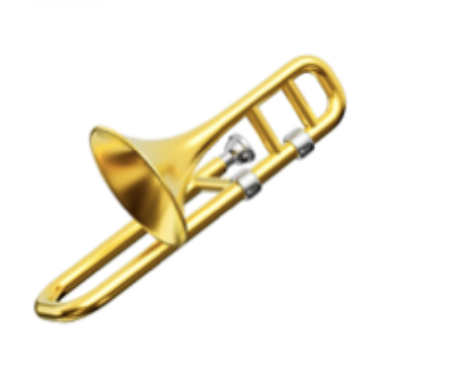
Today at last, the Trombone emoji!
Welcome U+1FA8A !
Today, Apple released iOS 26.4 beta 4, which includes a Trombone emoji.
wait… today? just where do emoji come from?
Glad you asked. There’s actually a committee - the Emoji Subcommittee of the Unicode Consortium - that meets every year to review proposals and vote on which ones should be included.
Every year a new version of the Unicode standard is released, usually with a handful of new, approved emoji. In 2025, version 17 of the Unicode standard was released, which includes a trombone emoji.
unicode ??
What the Unicode standard tries to do is to assign a code point to every conceivable character in every written language in the world. Software makers—Apple, Google, Microsoft, Meta, Samsung, anybody that might have to store and display text on the screen or in print—all agree that they’re going to stick to the definitions in the Unicode standard.
Everybody agrees as a result that the Unicode glyph known by its hexadecimal number as U+0041 represents the capital letter A, and that U+015C represents LATIN CAPITAL LETTER S WITH CIRCUMFLEX (Ŝ), and that U+304A represents HIRAGANA LETTER O お, and more, so that most written language can be encoded in a standard way.
(It used to be a huge mess before Unicode 1.0 came out in 1989 Nobody could agree on how to represent accented characters or currency symbols other than ‘$’. Text written on one computer couldn’t always be read on a different system - but I’ll skip most of that history lesson.)
Unicode doesn’t just encode written text. The standard also includes code points for punctuation, mathematical symbols, musical notation, and even ancient Egyptian hieroglyphics. U+13145 is EGYPTIAN HIEROGLYPH G006A which represents a falcon on top of a wickerwork basket: 𓅅
The current version, Unicode 17.0, defines a whopping 159,801 characters this way—which is 4,803 more that were standardized in Unicode 16.0 only a year earlier.
Those must be some fun committee meetings, but the result is pretty amazing - a standardized way to represent almost anything that’s ever been written down.
but what about emoji
Well, there’s an Emoji Subcommittee of the Unicode Consortium, that votes on which emoji will be included in each release. There are currently 3,790 emoji in the Unicode 17.0 standard.
Emoji 17.0 includes 163 new emoji - not just the trombone, but also DISTORTED FACE, FIGHT CLOUD, HAIRY CREATURE, ORCA, LANDSLIDE and TREASURE CHEST. It also includes a ton of variations of men/women/people wrestling, ballet dancers and people with bunny ears. (why so many? Unicode thoughtfully includes multiple skin tone variations for any emoji that represents a human.)
Wikipedia has a comprehensive Emoji chart of all of them. and Emojipedia has a good list of all the new ones in 17.0
I’m just interested in the trombone one, though.
a little emoji history
The history’s interesting. Japanese cell phones, starting in the 1990s, let you send little picture images in text messages. Like many things in our culture, the young people loved this, and the young people outside Japan wanted it too.
Here’s the set of emoji designed by Shigetaka Kurita and used by NTT Docomo in 1998.
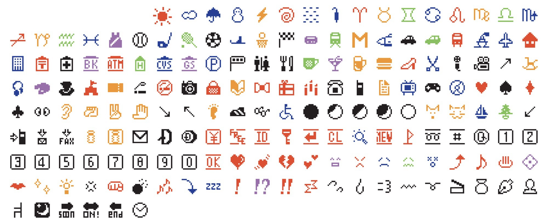
You can see that the first Japanese emoji were pretty crude. 12x12 graphics. You probably had to be a young person to have good enough eyes to decode what they were.
Aș people outside of Japan started clamouring that they wanted Emoji too, the Unicode consortium took note, and in 2010, Unicode accepted a proposal to include 625 new emoji, including many of the same ones in that Japanese set.
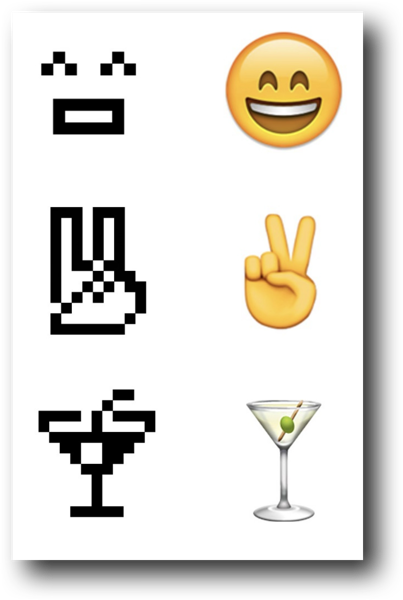
Here for instance are three of the original 1998 emoji, at 12x12, and what they look like today on an iPhone, part of Apple’s Apple Color Emoji font.
But how do you add new ones?
The Emoji subcommittee welcomes proposals for new emoji, and votes on them annually. As you might expect, the number of emoji keeps growing.
(At one point, the Unicode standard included emoji for only six different national flags, not including Canada, and you can imagine the amount of worldwide whining and complaining there was about that. Now, they’ve found a way to include all the flags, fortunately.)
There’s a whole guideline for submitting Unicode Emoji Proposals that you have to follow.
Only a few are accepted.
And in 2019, a group of high schoolers from Maryland pitched an idea for a trombone emoji.
Here’s their proposal.
They did a pretty nice job! Click the link above to see the full thing, but here’s page 1:
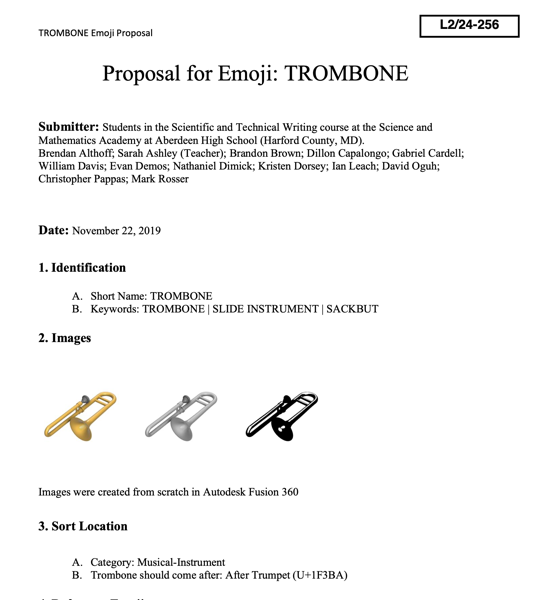
As required by the rules, you have to submit a sample graphic, and justify why none of the existing emoji are sufficient.
This proposal requests the addition of the “Trombone” Emoji to the Unicode library. A trombone is a brass instrument played by moving a slide in and out to make different pitches. They are popular in pop culture and places that enjoy jazz music. The trombone emoji could also be used to represent a mistake symbolizing the “wop wop wop woooop” sounds when a person fails at a task.
Welcome U+1FA8A !
The Emoji Subcommittee were persuaded, and voted to adopt this emoji as U+1FA8A in Unicode 17.0 in September of 2025. It takes a while for the software world to catch up. Apple and Google don’t just automatically use the graphic in the proposal - they create their own. Apple’s emoji, which finally appeared in iOS 26.4 beta 4 in March of 2026, are all contained in the Apple Color Emoji font.
Here’s Apple’s trombone - as a graphic, not an emoji.
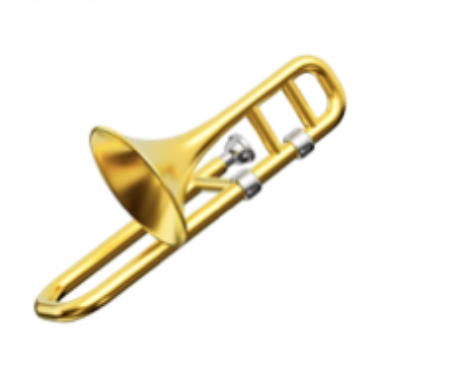
And if your system is up to date, you should see an emoji here - this is the actual glyph:
If that doesn’t look like a trombone, be patient. Your system will catch up soon.
wait, who draws the picture?
Each vendor agrees that U+1FA8A is a trombone, but they each get to draw it differently.
This can lead to humorous results - there was a time when the hamburger emoji on some platforms (cough google cough) was displayed with the cheese under the meat. That’s not how you build a hamburger! And the beer emoji showed the foam floating in air….
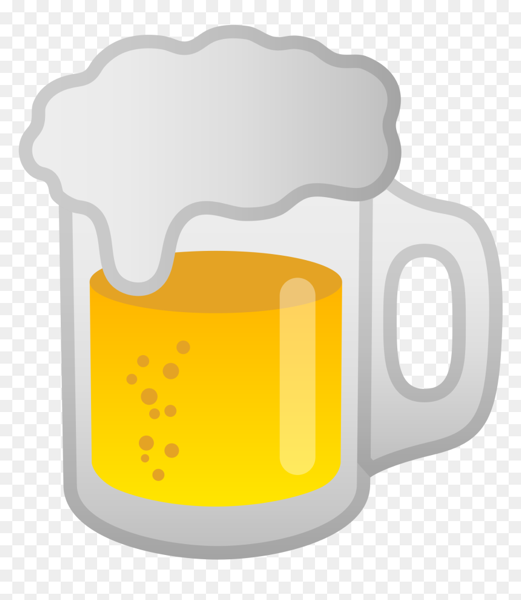
That’s not right either! Google’s CEO actually apologized and eventually it was straightened out.
one other proposal
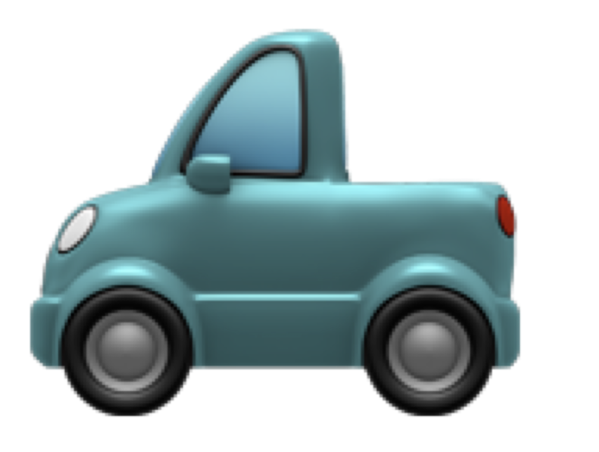
Also, somewhat famously, in 2018 Ford spent some serious money to propose a pickup truck emoji which included sample artwork that looked suspiciously like a Ford truck.
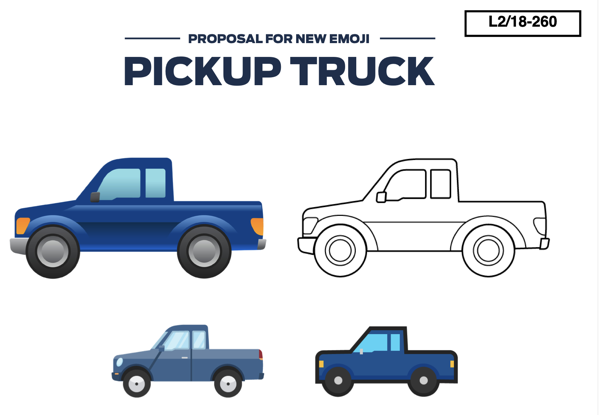
Perhaps they forgot, though, that nobody has to draw the emoji exactly the way you proposed it, or in Ford’s shade of blue, and today, a pickup truck emoji (at least on the Mac) looks like this.