
Remembering Uncle George reminds me: we should PRINT more pictures
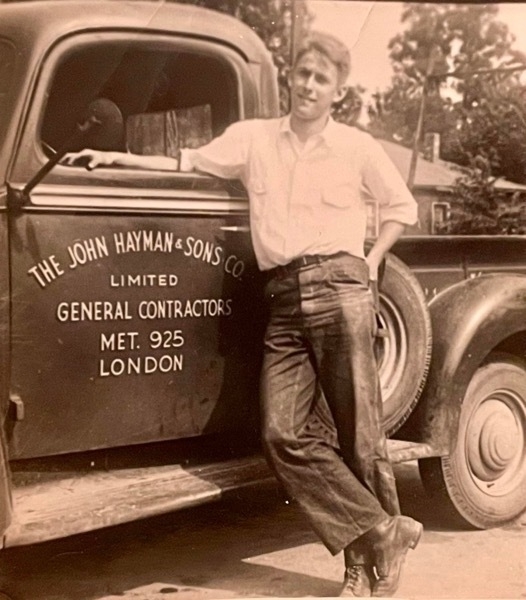
Here’s a wonderful picture of Uncle George (my dad’s brother) from 1950, that was on display at his funeral/celebration yesterday.
This is obviously a great photo of a handsome guy who we all loved very much. And a truck with a three-digit phone number! But here’s what strikes me about this:
Somebody - maybe my dad, maybe my grandfather - 72 years ago, took the time to take this picture, on a low-tech camera full of “film”, and waited a week or more for it to be developed and printed just so they could see whether it turned out OK, and they then put the photo in an album where we could all find it decades later and share in its majesty.
Conversely, what do we all do? We have amazing cameras with us all the time, we take dozens of high quality instant-gratification photos every week with our phones, and we never go through and delete the bad ones or highlight the good ones, and they get stored away in a cloud service and do we think our loved ones in 70 years are going to be able to unearth these?
We all need to PRINT more pictures. PRINT. Put them in a book where your grandchildren can find them and where you can enjoy them now. Don’t just store IMG_7305.JPG off in the cloud somewhere, hoping you can remember and find it later, hoping that that Facebook or Google or Apple’s service is still in business.
Somebody told me once of a service where you could just mark digital pictures as favourites as you took them, and once a month that service would scrape through your photo collection, find the new good ones, and print them in a small book for you. I kinda like that idea.
I am a big fan of printing elaborate hardcover photo books where you spend a lot of time futzing with the layout and getting the captions just right, except for the part where it’s hard to finish a project like that and that’s why I have 3 uncompleted photo books in progress at the moment. I gotta bring those to completion.
Of course it doesn’t help that every attempt to print a photo at home is doomed to end in nothing but cursing at the printer for either laying out the picture in the dumbest possible way on the page, or smearing the ink around somehow and producing very low quality output while simultaneously messing up your future attempts to print ordinary text because you’re now out of cyan. I wish our industry could fix this.
Print the good ones. Please.
Saying goodbye to Mom
(note: July, 2021, but just posted now.)
It’s been a tough year or two, saying goodbye to Dad, and Mom, and mother-in-law Eleanor, and Aunt Molly, and cousin Jon, and friends Linda and Ian, and so many others. I was honoured to give a few remarks at her funeral last summer and some folks wanted me to post them for posterity. Love you, Mom. I know you and Dad are watching us all, and, I hope, laughing and smiling.
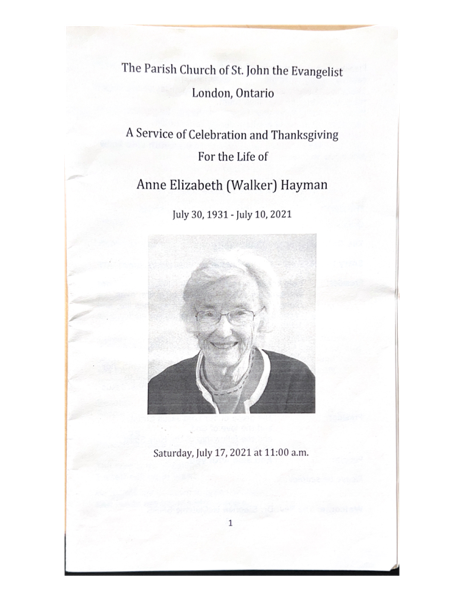
Anne Elizabeth Walker Hayman
July 30, 1931 - July 10, 2021
Remarks at Mom’s funeral, Saturday, July 17, 2021
Welcome everyone. Welcome to all joining us here at St. John’s, and also welcome to those watching on Zoom.
I don’t think Mom would have understood what Zoom was, but she would love anything that brought people together.
So, welcome again.
Welcome. That’s a word I’ve been thinking a lot about in the past week. So many people have told us how welcome Mom made them feel. Whether they were new to the Church, or new to Canada, or new members of our family like Brent and Cathy and many other happy spouses, or guests at dozens of Christmas dinners or hundreds of other gatherings, or they’d never been to the cottage before, Mom would welcome them with open arms.
Mom would welcome people to the cottage with a hand-written document called “Things in Odd Places." If you were looking for towels, or the can opener, or a gravy boat, or a dear little dish, you’d consult Mom’s Things in Odd Places list. Welcome to our cottage.
Mom also wanted to make sure we’d never forget those we’d welcomed, so most photos at home have Mom’s handwriting on the back with names and dates. Thanks, Mom. Some of those are pictures of my own babies and I’m not sure which one they are.
I also fondly remember one time in 1981 when Mom welcomed the entire University of Waterloo Warriors Band, which suddenly spilled out of a bus on our front lawn at 994 Maitland before a game against Western. Mom welcomed them all with a nice lunch, listened to the band as it played a couple of tunes on the street because, hey, why not, and then wished the band well as it headed off to Western. Where, if I remember correctly, the final score was 72-0, and not for Waterloo. But everybody remembered Mom’s hospitality. Especially one flute player in the band, who met Mom back then, and then again 30 years later when she married me. But that’s another story.
Mom was born in 1931 and lived, just a couple of blocks up that way, at 944 Wellington with her parents, Alexander Illingworth Walker - everybody called him A.I. - and Audrey Walker - we called her Nanny - and her older brother John. Two years earlier, older brother Joe had passed away in a tragic accident, so I know Mom’s arrival must have been very special for them all.
A.I. worked for the Canadian Pacific Railway - just over there, at the magnificent CPR station. Mom and Nanny thought nothing of hopping on the CPR train to Detroit to go shopping. For years Mom spoke glowingly of “The Big US”, a magical land where you could buy things that weren’t available in Canada. And it was easy if you could just hop on the train for free.
Mom went to The Until Recently Ryerson Public School which, it turns out, had been built by her future husband’s grandfather. Our family has had a long connection with the School at Waterloo and Victoria, and that over-a-century tradition has continued - granddaughter Katie has just graduated from Grade 8.
In grade 3 and 4 at what was then Ryerson, one of Mom’s classmates was a boy who lived up the street named Roger. I wish I had found out about this earlier so I could ask mom what she remembered of him, but that boy, who learned arithmetic right alongside Mom, went on to win the 2020 Nobel Prize in Physics. Sir Roger Penrose. One of the most famous mathematicians of the past century - and he was Mom’s classmate. Well - that gets me excited at least.
Mom continued on to high school at dear old Central, the school that claims our loyalty. With colours royal. True hearts and loyal! As we go marching onward, onward to victory - sorry, I’m lapsing into the Central song there. Mom heard that song dozens and dozens of times, as she and Dad faithfully came to every single music night that any of her children were ever in, and from her I learned a valuable lesson: You have to stay to the end! You can’t leave just because your kid’s group has finished! You have to grit your teeth and enjoy the beginning string class too!
She even came to Toronto for some of her grandchildren’s musical performances - and I remember her visiting - on the train, of course - to hear the Runnymede Public School Kindergarten Christmas Concert, where she surely enjoyed the choral performance even though Nick never opened his mouth to sing once. Mom thought it was wonderful.
And then for Mom it was on to Western. Did you know Mom played basketball for the Western Mustangs? I discovered that old Western yearbooks have been scanned and can be browsed online.
To my great delight, in the 1953 Occidentalia yearbook, I found a page dedicated to the candidates for Queen of the University College Ball. Let me share with you a few excerpts about one of them.
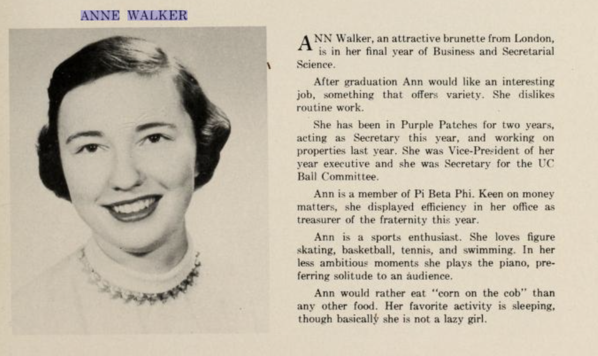
The first thing you noticed is that they incorrectly spelled “Anne” without an “E” multiple times, something Mom battled her entire life. (For the record, I am “Stephen” with a “PH”. Thank you for that, Mom.)
Let’s learn about Ann Walker.
Anne Walker, an attractive brunette … is in her final year of Business and Secretarial Science. After graduation, Ann would like an interesting job, something that offers variety.
Yes, she certainly was an attractive brunette, and she won the Gold Medal in Business and Secretarial Science - she found an interesting job at Labatt’s, where, amazingly, she had an aptitude for beer tasting.
John Hayman and Sons Construction happened to be doing some work at Labatt’s, and one day a young U of Toronto civil engineering grad named Bob was having lunch with his friend Harvey Hurlbutt.
(Ask Dad to tell you this story. He loves telling this story.)
Bob noticed an attractive brunette entering the cafeteria, and asked Harvey who that was. Why, she’s a friend of my girlfriend Frances Branton, he replied. She can introduce you!
That’s how it got started. On one of their early dates, Dad took Mom to see professional wrestling at the old London Arena. Pro wrestling. Dad likes to say that Mom “never complained”, but, well, I’m not sure what she would have thought of that.
Back to the yearbook.
Ann is a member of Pi Beta Phi. Keen on money matters, she was treasurer of the fraternity
Yes she was keen on money matters. I remember at age 4, a major construction project had Maitland Street torn up, and I decided to have a lemonade stand. Get your lemonade right here! Five cents a glass!
Some of the workers would offer me a quarter. Wow. A whole Quarter. Thank you!, I would beam.
And then Mom announced that
I had to make change, I couldn’t keep the entire quarter, and
I also had to pay her for the cost of the lemonade.
Keen on money matters indeed.
Ann is a sports enthusiast. She loves figure skating, basketball, tennis and swimming.
Mom’s love of figure skating took her to lots of events, and when she learned there were actually organized group tours to the World Championships, off she went. Mom loved those trips with Blanche Ward and Janet Cluett, off to Prague, or Indianapolis, or wherever, where they could chat about skating, music, outfits, and unfair judging all day long.
We kids did not exactly develop into Olympic skaters - although Mom took great pride in Rob and Katie’s hockey teams - but at least we learned to identify some of the jumps as often as 60% of the time. Here’s a tip I learned from Mom. The only jump where you take off going forwards is an Axel. Look for that at next winter’s Olympics.
Also - Tennis! Mom loved tennis! I never saw her play tennis, but we sure saw her play Table Tennis. Even up until her later years, Mom was a ping-pong shark. My cousin Kathy says that Mom was the only person who could ever beat her dad, John. And even in her later life, Mom would come alive playing ping pong at the cottage. It’s fascinating which skills stick with you, isn’t it.
In her less ambitious moments, she plays the piano, preferring solitude to an audience
Mom took piano lessons from Miss Taylor, over there on Colborne St, and insisted we do so as well, although Miss Taylor was about 900 years old by the time I started. Thank you for that, mom. Susan played the piano for Mom last week, and I can report with great pride that the last live music Mom heard was Susan’s perfomance of the classic “Yes We Have No Bananas."
Susan even kindly played it without the extra C#’s I would occasionally add just to see if Mom was listening.
Ann would rather eat corn on the cob than any other food.
August was Mom’s favourite month. By August, the corn on the cob that she’d buy at roadside stands was at its best. Also by August, Lake Huron was finally warm enough for her to swim. Always entering backwards, always keeping her head above water.
And perhaps the best quote about Mom from the yearbook -
Her favourite activity is sleeping
Mine too!
So. With a resume like this, how did she NOT win the UC Ball competition? I demand a recount!
But she won the grand prize - the beer-tasting secretary married Bob, a loving marriage that lasted 65 years, a true partnership in which Dad would have big ideas and Mom would somehow find a way to make them work.
Just up the street at St. Joseph’s hospital, Mom had four children. You know three of us, but you might not have heard of Tim, who never made it out of St. Joseph’s. It’s hard to imagine how devastating that must have been, but Mom showered Dad and the rest of us with love.
Life at 994 Maitland with Dad was full of variety. Of course I remember the vacations - Expo 67, the 1969 Apollo XI launch, which Michael and I have been bragging about witnessing for 52 years, trips to the Calgary Stampede, to England, to France, skiing in Austria, but I also remember Mom’s desserts. Jello 1-2-3! Mom made this miracle product that nobody today has ever heard of. And Mom’s famous Frozen Strawberry Dessert, which I forget the recipe but I believe the main ingredient was frozen strawberries.
Mom and Dad travelled the world too, once they realized they didn’t need to bring us kids along. Cruising the Atlantic, bicycling through France with the Whelens, even a once in a lifetime visit to Australia’s finest resort, Hayman Island.
After a lifetime of volunteering, Mom finally found her most interesting job - remember she wanted one that offers variety, one that had no routine work. In 1993 she was promoted to Grandmother. Alexander - named for her father - arrived, and then Nicholas, and Robbie, and Katie, and just when she must have thought it couldn’t possibly get any better, along come Tyler and Caitie-with-a-C. We told her that Tyler recently got engaged to Diana, and that Caitie is a daredevil at the CN Tower, and I hope that made Mom smile.
Grandchildren, Mom truly loved you. I remember a saying she liked. “If I’d known how wonderful grandchildren were, I would have had them first.” Thank you for escorting her on her final journey today.
Mom had two favourite expressions. One of course, was “Oh, Bob.” But the other was the last word she’d always say to me if I was heading out. She’d say “Stephen - drive carefully!” Every time. And I would try. But today it’s my turn to send her off.
Now, I don’t know what happens when you die. I have a good idea what happens scientifically, but spiritually? I don’t know. But I like to think that you get to meet everyone who went before, and that they’re all very eager for you to tell them stories of what they’ve missed.
So, Mom - Nanny and Bompa are waiting for you to fill them in. And Uncle John. And your brother Joseph who you never met, and our brother Tim, who we never met. Please give them all a big hug from us, let them know we’re all doing great, that we’re taking care of Dad, and that we’ll miss you forever.
And we’ll all Drive Carefully.
epilogue
Mom was escorted out of St. John’s Church on her final journey by grandchildren Alex, Tyler, Nick, Caitie, Rob and Katie - as the organist fittingly played The Skater’s Waltz.
Presentation Tips you Might Not Want To Use
I’ve been fortunate to deliver sessions at Apple’s WorldWide Developer Conference (WWDC) in California on many occasions, and have learned some good things about presenting.
These are not those things. But I’ve saved them here for posterity, because I think after 20 years, the statute of limitations has expired.
Be Sure To Wear the Speaker Shirt
WWDC 2002, WebObjects Technical Overview
It’s important that everybody wear the special speaker shirt.
My thanks to engineering manager Toni Trujillo Vian who went along with this dumb idea that was presented to her about two minutes before the session started.
See If You can Get the Crowd to Stand and Sing
WWDC 2001, WebObjects Technical Overview
What session would not be improved with a singalong? Well, perhaps this one.
(This was actually the second time I got a WWDC crowd to stand and sing. In an earlier session on the very dry topic of WebObjects debugging, we staged the World WebObjects Debugging Championship at the end (between a couple of good-natured volunteers from the USA and Canada) and played the anthem of the winning country at the end. Congrats, Mark Ritchie of Canada.)
Saying goodbye to Dad
My father passed away last week and we had a lovely, but unfortunately capacity-limited, funeral for him on Saturday at our family church, the Church of St. John the Evangelist, in our old neighbourhood in London.
I was honoured to make a few remarks (below).
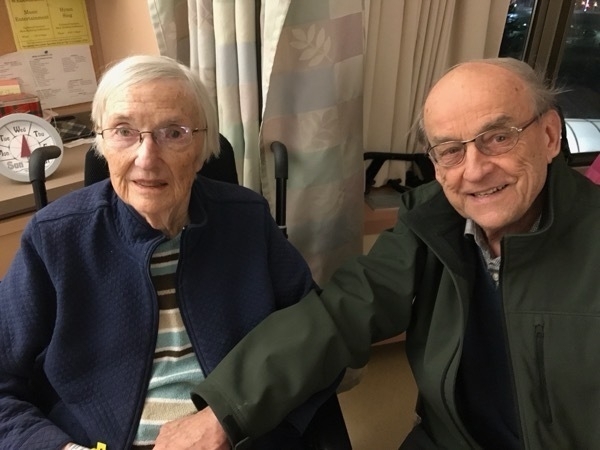
Mom and Dad had been members of the church - pillars, really - for over 60 years, and I was delighted that the Choir (of which Dad had been a long time member) was able to attend and sing some of Dad’s favourites. Dad had asked for John Rutter’s The Lord Bless You and Keep You to be sung, and the choir did it magnificently.
Here’s a slightly larger choir performing this wonderful work. I am extremely grateful to our choir for singing this one. (I could barely hold it together while listening to it.)
It was wonderful to see family and old friends at the visitation and later at the funeral service. Thank you to all who came, or who watched the live stream. That made the week easier.
I was honoured to deliver a eulogy for Dad, only a few months after doing the same for Mom. Here’s what I said, with more than a few pauses where I could compose myself. Dad, people laughed in a few spots. I hope that’s OK.
Eulogy for Dad
Welcome back
Well, welcome back everyone. It seems like we were just here.
Mom and Dad both loved the theatre. So in that vein …
Welcome back from intermission. Previously at St. John’s, in the Act One finale last July, we said goodbye to Mom, Anne, Gran, Mrs Hayman, a wonderful star to whom Dad was devoted for 65 years.
Today is Act Two. I want to tell you some stories. We have four scenes. Let’s get started.
Scene 1: Bob the Technophile
When Alex was born, Dad couldn’t understand why I felt the need to give a newborn baby an email address, and he wrote an editorial for our family paper the Point View Reviewer wondering why we didn’t just come up with a way to print messages on paper and deliver them through Canada Post. But … he changed. He grew to love online communication. And he’d want me to welcome everyone joining us on Zoom today. Even though Dad would have no idea how that worked, he loved anything that connected people.
Dad was fascinated, although often stumped, by technology. A slide rule was high tech when he was a student. But he adapted easily to this new world. For instance he’d love seeing the list of people who liked or commented on a Facebook post, and it was great fun trying to explain to him who everybody was. OK see those are my high school friends, there’s someone from the band, that’s your neighbour and … I don’t know who that is, one of your Internet friends maybe?
Dad was an amazing early adopter. In 1971 he bought the first pocket calculator any of us had ever seen! He let me take it in to wood shop class, where the teacher was so impressed, he helped me build a beautiful stand for it. It was so early, we didn’t even realize you could spell words on a calculator by turning it upside down. We just multiplied 4 by 7 and went, whoa, it figured that out in two seconds.
And he bought an Apple ][ years before anybody else had a “home computer”. He soon became the first person I knew to buy an airline ticket online! He had signed up for an account on “The Source”, an early nationwide bulletin board, that cost $15/hour to use. Somehow he found a travel agent in there selling tickets, and he experimented a bit and, apparently, actually purchased a return ticket from Toronto to Paris, or something. Of course he had no intention of travelling to Paris, he was just experimenting with this technology …- and we had to persuade him that yes, we think that was an actual thing, we think you actually DID buy a plane ticket there, you better call them back and cancel it.
Years later, in 1996, Steve Jobs demoed buying a plane ticket on the Internet, and immediately called United Airlines to cancel it, and everybody went, “oooooh, cool, that’s the future”, but I remembered Dad had done it fifteen years earlier.
He went through a brief spell where - being an engineer - he wanted to understand how computers worked, how you wrote programs for them, what was actually going on inside these boxes. That phase didn’t last. He wisely decided he would just enjoy using the computer. He’d leave that understanding part to others. Good move. Let the experts be the experts. We did have many discussions about the difference between a “file” and a “folder” though, as Dad pointed out that a “filing cabinet” actually holds “files” and my analogies were all wrong. Taught me a lesson there.
That Apple ][ got me curious, and here I am in my 29th year of working for Apple. Dad was always very encouraging about that even if he was a little unclear what it is I do here.
I overheard him telling somebody once that “Stephen is in charge of education sales for Apple”, which is, um, overstating it slightly. But he was proud of whatever it was.
Scene 2: Bob the Performer
When Dad was in high school at Rothesay Collegiate in New Brunswick, he organized the school’s bugle band, and something must have clicked because he enjoyed performing for the rest of his life.
Dad finished high school at London South, and here’s a quote from the 1946 South yearbook, describing a school assembly.
The program was continually being interrupted by the unscheduled appearances of Walden Allen, Dick Hutchison and Bob Hayman, who pestered the audience with skits and songs. But the people loved them.
The performing bug continued when Dad was studying engineering at the University of Toronto. He tried out for U of T’s Blue and White marching band, but it turned out they were looking for people who could actually play an instrument.
So Dad pivoted and founded the Inter Varsity Barbershop Quartet Champions of 1949, the legendary Four Flushers, from Drano, California.
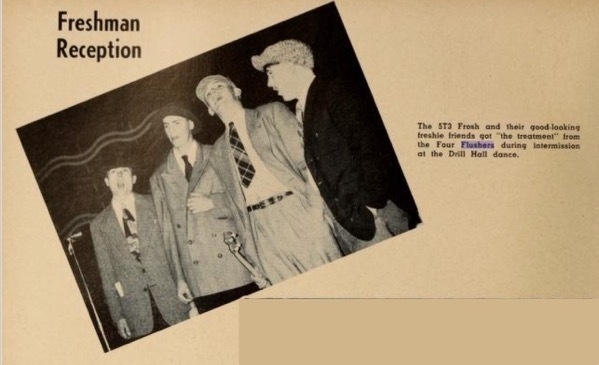
The Four Flushers, from the University of Toronto 1950 Engineering Yearbook
On the evening of February 21st, the men of Civil Engineering grabbed their best gals and headed for the Savarin Hotel. A swell evening was had by all. The "Four Flushers," of 5T0 Civil and international fame, comprised the official entertainment. After singing several numbers, the quartette was forced, by popular demand, to give its rendition of that old folk song—"Cigareets and Whisky." The roof promptly fell in.
Dad also managed to appear in some London Little Theatre musicals. I remember him boasting of being in a production of Guys and Dolls, where he played The Greek. Now, I was very impressionable, and grew up thinking The Greek must surely be the star of that show, so imagine my confusion when I finally saw a production of Guys and Dolls and learned that The Greek only had about two lines. No matter! It was Show Business.
And yet some of Dad’s greatest artistic successes occurred right here, at St. John’s Church. I’d like to speak to the choir for a moment.
to the choir
Dad was a member of this wonderful choir for many years. He loved worshipping and singing with you all, but he loved socializing with the choir even more. Thank you, David, and everyone else for being here today and singing some of Dad’s favourites.
But he also founded the legendary St. John’s Marching Band in 1971. Dad would play the trumpet, sometimes - I never did figure out where exactly he figured out how to play the trumpet - or maybe the violin, and my siblings were in it too, along with whoever else in the church played any instrument at all, and the band would play for the Christmas pageant or the Lessons and Carols service, and then scatter until next year - unless the church was running a Chicken Dinner or putting on a show or a road race, and then the a slightly different St. John’s Marching Band, sometimes enhanced with a few ringers, would reassemble. We are all grateful that St. John’s has had a series of directors of music willing to embrace this ensemble. I am grateful for their tolerance and senses of humour about the whole thing.
Mom and Dad would host Christmas or Victoria Day parties and invite the entire neighbourhood, and a new ad-hoc orchestra would be formed. And with Dad and Uncle George on trumpet, my siblings on clarinet, me on trombone, Mom on the piano and other cousins on whatever instrument they were learning, the family band would get together on Christmas Eve and visit Grampa and Nana and Uncle Don and Aunt Grace and Aunt Jean to serenade them with Christmas carols from the well worn red and green books.
And the nightly flag lowering at the Point View cottage was always accompanied by a bugle solo, that could be heard far and wide. Dad was big on ceremony.
He and Mom travelled to Europe with Western’s New Horizons Band, playing to, if not exactly the great concert halls, various nursing homes. Talk about a captive audience.
I was inspired by all this and put a few bands together in my life and Dad was a great supporter, especially when the University of Waterloo Warriors Band would occasionally visit London and play a tune or two on the lawn at 994 Maitland St. before going off to see Waterloo edged by Western 72-0. Cathy was in one of those bands too, although I didn’t get around to marrying her until 30 years later. Y’see? You should join a band. Or a choir. A lifetime of memories is there for you.
Here’s the thing. I learned a valuable lesson from these groups Dad would assemble. Musical quality isn’t the important thing. No. What’s important? Just getting together with your friends and playing some music, and having fun, now THAT’s important.
Thank you, Dad
Scene 3: Bob the Traveller
Dad loved to travel. His philosophy was that money wasn’t doing you any good in the bank, so you might as well travel. And travel, he and Mom did. They saw the world. Sometimes they even took us.
Mom and Dad took our family on some memorable trips, including a mission in 1969 to see the launch of Apollo XI. Michael and I have been bragging about that one ever since - and that is what personally got me interested in science and technology.
I remember a wonderful two-motorhome trip with the entire Jones family. Mr. and Mrs. Jones owned a motorhome, Dad rented one, and we spent a great weekend arguing the merits of Champion vs. Superior motorhomes.
Mom and Dad also shared their love of theatre with us, and we all went to New York in 1978 to see some Broadway shows. We all remember Dad gasping at the ticket prices.
"$28 each?" he’d say. “That’s absolutely ridiculous, you should be able to take the whole family to a show for $28."
The most memorable trip was to France in 1980. Imagine, trying to book travel for your family without the Internet, just with brochures, to a country where you didn’t speak the language. Dad’s bold speech at every hotel , using the remaining words of high school French he knew, became part of family legend. We’d all repeat this line to ourselves for years. Dad would stride up to the hotel, counter, and smile, and loudly tell the clerk
"Je Voudrais Doux Chambres pour Cinq Personnes."
(That’d be “I Would Like Sweet Rooms for Five People”.)
Somehow that worked and we got our two rooms for five people.
We visited the world war 1 grave of Dad’s uncle Gordon McIntosh, killed at 19 in World War I in Lapugnoy, France. Dad made sure we were aware of those sacrifices, and of how hard Gordon’s death was on his mother, Gordon’s young sister. It was a very moving trip.
Also I remember we detoured through Belgium at one point because Dad wanted a real Belgian waffle.
Mom and Dad made many more great trips once they realized they didn’t need to bring the kids along, including a round-the-world trip where they flew to France for cousin Ian Hayman’s wedding, and then - seeing as they were already in the area - continued on to visit other cousin Ian Wallace in the Philippines. And on to Australia’s finest luxury resort, Hayman Island.
They cruised the seven seas, they saw the pyramids along the Nile, they cycled through France with the Whelens, they skied in Austria, but they enjoyed travelling to the family cottage at Point View on the shores of Lake Huron most of all. The family cottage wasn’t just our family, it included the entire MacFarlane and Baldwin clans across the ravines too.
Dad saw to it that family gatherings at Point View were frequent, and fun, and frequently filmed. A whole series of movies were shot on Dad’s Super 8 camera, starring every kid who was around, including classics you might remember like The Shed, or You Axed For It, or Quest for the Holy Pail. Movies with plots and special effects and soundtracks and everything. It was a regular Hollywood-on-Huron directed by Dad, H. R. Spielberg himself. And Dad would edit the movies - no small feat, you kids might not get this but back then editing a movie actually involved “cutting” film with a razor blade and gluing it back together, with the constant risk that the film would jam in the projector and melt your masterpiece.
We’re all so lucky that Dad created these moments on film, and preserved them and then showed them over and over and over again whenever guests were at the cottage. What a gift that was for the next generation.
We did our best to repay this - Cathy and I took Mom and Dad, and Cathy’s mom Eleanor, on a Caribbean cruise a few years ago. Sadly, all three of these wonderful people have passed away in the past year, but the picture of the three of them in Cozumel, enjoying frozen beverages while wearing silly balloon hats will make me smile forever.
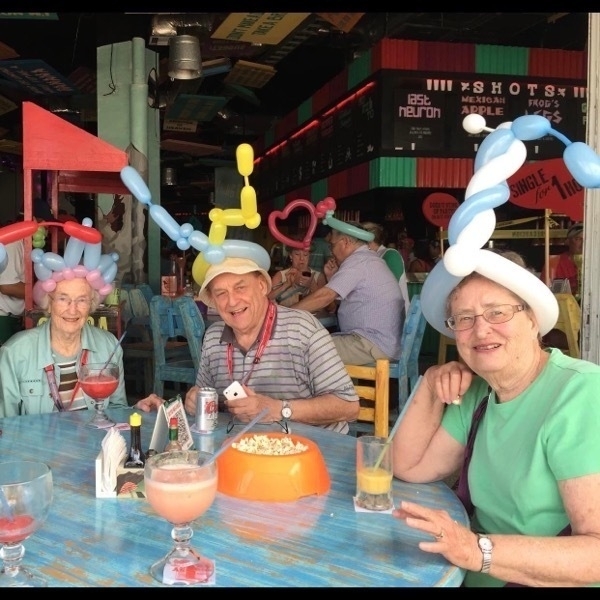
Thank you, Dad
Scene 4: Bob the Builder
Dad was a builder of buildings, of course - a general contractor with John Hayman and Sons, building buildings all over southern Ontario. A great occupation where you build permanence - structures you can point to decades later. (Unlike, say, the computer business, where programs I wrote last year don’t work any more.). He built buildings.
But he was also a builder of family. And not just family who lived in his house - family meant cousins, and second cousins, and sometimes kids in the neighbourhood who we just assumed were our cousins and they just figured Dad was their uncle. I’m honoured that so many of you from Dad’s big extended family are here today. Welcome, especially, to Kathy from Houston, Lisa from Atlanta, and Ian from France.
On an early job of building buildings, he was helping build something at the Labatt’s head office here. One day, eating in the Labatt’s cafeteria, he asked his engineering friend Harvey Hurlbutt who those pretty girls over there were. And Harvey happened to be dating one of them, and offered to introduce Dad to the other. That was Mom, also working at Labatt’s. They - obviously - hit it off, married in 1956 and loved each other deeply for 65 years.
You know Michael and Susan and me, but you might not know of our brother Tim, their first baby, who never came home from the hospital. Ever the engineer, Dad insisted that the nurses explain Tim’s spina bifida condition. And he couldn’t do anything about it. I cannot imagine how devastating that must have been to this new couple. But Dad supported and loved Mom unconditionally, and while he was building London, he was also building a family.
At their home, Dad built a coffee table out of, probably, lumber he’d scrounged up on a job site - and Mom gently suggested that perhaps fine finish carpentry was not his best skill.
But he was also building skating rinks in the backyard - and, naturally, making dramatic films of mythical hockey matches played there. One squad of neighbourhood kids taking on another, and the underdogs would always triumph because that made for a better movie.
Dad mentioned to me that he knew it was time to retire when the company started working on jobs that involved demolishing buildings he’d built at the start of his career. After retiring, he kept a hard hat in the car, and found a new calling inspecting churches around the province. For this, and many other contributions, the Diocese awarded him the Order of Huron.
Dad was proud of Michael joining the family firm and of Susan’s neuropsychology career, and he warmly welcomed Cathy and Brent to the family. And the family kept growing to another generation. Four day old grandson Alex was the star attraction at Dad’s 65th birthday party. Jenni reminded me Dad made it his mission to get this baby to laugh, even if it took all summer, and when Alex finally did, it was glorious.
Nick arrived a little later, and then Rob and Katie, and as a special bonus, Tyler and Caitie-with-a-C. Dad adored all six grandchildren, and was looking forward to Tyler’s wedding to Diana this summer - and I am deeply honoured that his grandchildren are escorting him on his final journey today.
Dad, the Builder. He built communities. Not just structures, but connections.
All along, Dad was completely devoted to Mom. His favourite expression about Mom was that “She never complained.” We kids had our doubts about THAT - like, really, what about this incident, or that one? - but Dad insisted. She never complained.
Mom and Dad were able to live out their lives at home at 994, which is what they both wanted, and I have to acknowledge all the work that my brother Michael did every single day to make that possible. And we are extremely grateful to the compassionate staff of Medical Priorities.
Now … I don’t really understand what happens when you die. I like to think you get to meet everybody who passed before you, and fill them in on what’s been happening. I hope Dad gets to reconnect with his wonderful sister Molly and brother Donald. And baby Tim too. Let them know how we’re doing.
When Mom passed away last summer, I do know that it left a huge void in Dad’s heart.
But I imagine Mom has been complaining, for the first time, wondering where on earth Bob was.
And Dad surely felt those complaints, and decided that wasn’t right, and did what he could to join Mom again. So, last Saturday, while listening to Anne Murray sing his favourite song, he slipped quietly away, with Michael and Susan and me at his side, to be with Mom again. And I know the first thing he asked her. Could he have this dance? For the rest of his afterlife?
And Mom surely answered, “Oh, Bob.”
Thank you, Dad, for everything.
Dad, and technology
I really want to thank everybody for the kind words about Dad.
One of my favourite things to do was to show him everybody who’d commented on a Facebook post or Twitter thread or blog mentioning him, and explain who they all were - look, here are some old high school friends, here are some people from work, here are your neighbours, here are people from Argonotes, here is - wait, I don’t know who this is, is that some friend of yours? - etc etc - and Dad was always fascinated by that.
I’m sad that I won’t be able to do that this time, but I know he’s smiling at how many people are being kind and thoughtful. Which is what he was all about.
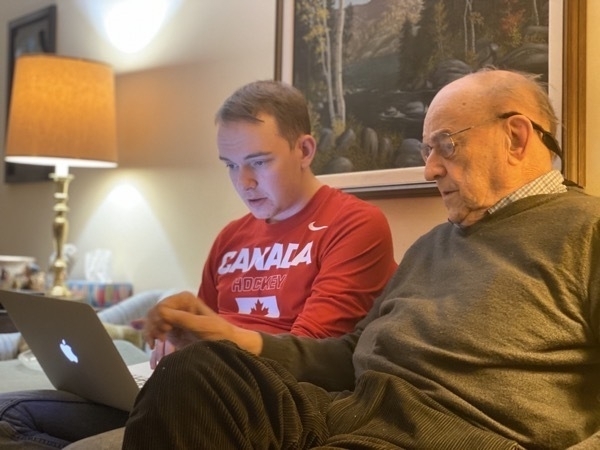 Nick, patiently trying to explain something to his grandfather
Dad bought an Apple ][ for our family long ago, before almost anybody had even heard of a home computer, and my sister reminded me that when I saw it under the Christmas tree, I grabbed it and took off to set it up before she even knew what it was that had been unwrapped.
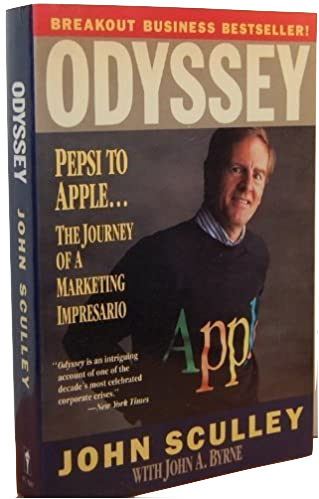
Another Christmas, Dad gave me Odyssey, the autobiography of John Sculley (former Apple CEO) just as I was giving him the exact same book.
And here I am finishing up my 29th year at Apple. Dad was always pleased about that even if he was a little unclear what it is I do here (and to tell you the truth, I’m sometimes a little unclear about it too.)
I overheard him telling somebody once that “Stephen is in charge of education sales for Apple”, which is, um, overstating it slightly. But he was proud of whatever it was.
He bought some stock in Apple, right after I started here. His financial advisor was somewhat aghast - why would you do that? They’re struggling. But he had faith, and I think those, I dunno, ten shares he bought worked out nicely, and he always enjoyed reminding his advisor that the advisor had been completely wrong in this case.
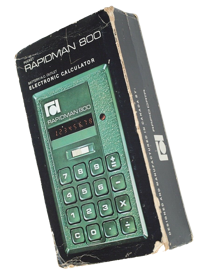
He always took great interest in technology - Dad bought the first calculator anybody had ever seen, the Rapidman 800 in 1971, and I took it to wood shop class. The teacher was so impressed, he helped me build a beautiful stand for it in return for me letting him play with dad’s calculator. I think that was long enough ago that it didn’t even occur to anybody that you could spell words by turning it upside down. You’d just multiply 4 by 7 and be amazed.
Then after our family got the Apple ][, Dad became the first person I knew to buy an airline ticket online! He had signed up for an account on “The Source”, an early nationwide dialup BBS system (later acquired by Compuserve) and had somehow found a travel agent in there selling tickets, and he experimented a bit and, apparently, actually purchased a return ticket from Toronto to Paris, or something. Of course he had no intention of travelling to Paris, he was just trying out the user interface of this thing - and we had to persuade him that yes, we think that was an actual thing, we think you actually DID buy a plane ticket there, you better call them back and cancel it.
Years later, in 1996, Steve Jobs demoed buying a plane ticket on the Internet, and immediately called United Airlines to cancel it, and everybody went, “oooooh, cool, that’s the future”, but I remembered Dad had done it fifteen years earlier.
He went through a brief spell where - being an engineer - he wanted to understand how computers worked, how you wrote programs for them, what was actually going on inside these boxes. That phase didn’t last. He wisely decided he would just enjoy using the computer, without worrying about how it worked. He’d leave that latter part to others. Good move.
Dad loved Facebook too. He couldn’t use it much in his later years, but Facebook memories still pop up for me - just yesterday, Facebook reminded me of a conversation Dad and I had had 12 years ago where he’d installed Skype, but didn’t “get it.” Me neither, Dad.
Thank you again for all the kind words. My brother and sister are taking great comfort in it all, and I know we’ll have many more stories to share.
Howard Robert (Bob) Hayman, 1928-2022
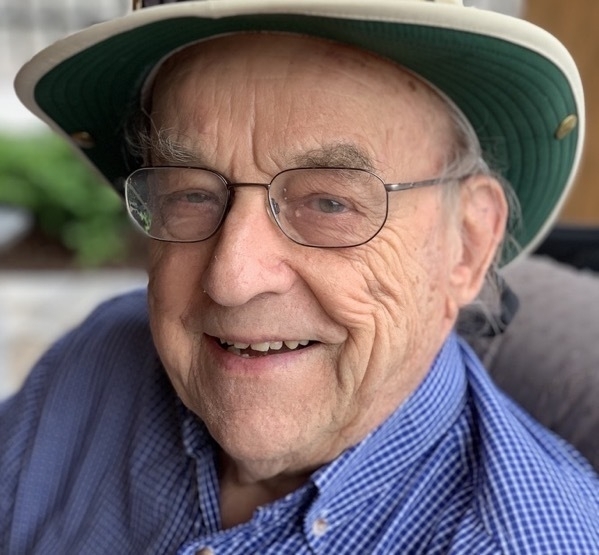
My brother Michael, my sister Susan and I are very sad to report that our wonderful Dad died on Saturday. He slipped away peacefully, listening to his favourite Anne Murray song, and he’s now with Mom again, asking her if he can have this dance.
I’ll write more stories about Dad soon.
This notice will be in the London Free Press this week.
HAYMAN, Howard Robert (Bob) - On Saturday, March 5, 2022, Howard Robert (Bob) Hayman, P.Eng, loving father and devoted husband, died in his 94th year.
Bob was a devoted husband to Anne Elizabeth (Walker) Hayman (d. 2021), whom he cherished and adored for over 65 years. Bob’s commitment and loyalty to their church, St. John the Evangelist, was well known and appreciated by many, and he was named to the Diocese’s Order of Huron.
Bob was born on June 15, 1928 in London, and moved during World War II with his family to New Brunswick where his father was supervising wartime military construction projects. He attended Rothesay Collegiate School, and returned post-war to London where he graduated from South Collegiate.
Following in his father’s footsteps, he studied Civil Engineering at the University of Toronto, and was a fiercely proud 5T0 alumnus. Returning to London, he spied Anne, a beautiful Western graduate, while both were working at Labatt’s. They married in 1956. Bob and Anne built a family, and saw the world.
Bob spent his entire career with the family construction firm, John Hayman and Sons, founded by his great-grandfather. He retired in 1999 as its president. Their work appears all over London and Southwestern Ontario.
Bob shared his musical talents and song parodies with us all, equally proficient on piano, trumpet, violin, ukulele and the gut bucket. His Christmas poems were unsurpassed, and many occasions were celebrated in song. Bob truly loved making memories for all at the family cottage at Point View, Lake Huron. His passions for life and learning were matched only by his seemingly limitless joy and curiosity, which he shared with all he met.
Pre-deceased by his parents Howard and Helen (McIntosh), his dear brother Donald (d. 2008), beloved sister Molly, (d. 2021) and his infant son Timothy (d. 1958).
Admired and adored by his children Stephen (Cathy) Hayman of Oakville, and their children Alex, Tyler (Diana), Nick, and Caitie; Michael Hayman of London; Susan (Brent) Hayman-Abello, and their children Robbie and Katie of London.
Loved and missed by brother George Hayman and his wife Helen, in-laws Lenore (Donald) Hayman, Martin (Molly) Ware, and many nieces, nephews and extended family.
The family is extremely grateful for the many services of the Dementia Day Program at the McCormick Home, and for the caring staff of Medical Priorities.
In lieu of flowers, Bob’s family would be pleased if you made a memorial donation to the Endowment Fund for Music at St. John the Evangelist Church, or the London Kiwanis Music Festival.
Young people, a tech tip for you. Listen up!
Save a piece of cool tech you use today, so you can show it off and bore people in 30 years with how tough you head it when YOU were getting started.
Teaching Math in Ontario
Ontario has - well, “had”, because it was just ruled unconstitutional - a Math Proficiency Test for new teachers. Which has been quite a topic of discussion around here, as my daughter is just finishing teachers college, and my future daughter-in-law is currently teaching.
In another version of my life, I thought I’d be a math teacher. I’d be that cool teacher who gets the kids excited about math (and also directs the pep band.)
so I woke up this morning and I thought, you know what would be fun? Why not try the practice test and see what this is all about?
Perhaps this is an odd definition of ‘fun’ but I enjoyed going through the test.
71 questions. 2/3 of them are on math, and 1/3 on pedagogy, and then there’s an optional questionnaire. I believe 70% is a passing grade. For the past year or so, all new teachers were required to pass this, but the future of the test is up in the air at the moment.
plunging ahead
This, believe it or not, is one of the actual questions. (I got this one right, phew.)

What on earth is going on here? Is this an attempt to catch bots, or people who always answer “B” to every question, or a test to see if you’re reading, or was there originally some question that they later decided was inappropriate?
the math part
I did not have much trouble with the math part. Some of the questions let you use a calculator but as a show of mental toughness I decided to try doing all the questions in my head. Got one wrong - dumb arithmetic mistake that I’m sure I would have caught if I used the calculator.
Some of them are unbelievably basic, like (paraphrasing)
In the number 470,253, the digit ‘7’ represents what?
- 70
- 70,000
- 700,000
- 7
Others require you to evaluate a little expression using BEDMAS (“What is 16 - 2 * 3 + 5 * 0”, that kind of thing) which if you’ve been on Facebook any time in the past year, you’ve seen some idiot version of this which has fourteen million wrong answers in the comments.
And at one point I had to pause for a moment to try to recall the formula for the area of a parallelogram - one question showed you a parallelogram, gave the lengths of the sides, and said “if you divided this into two congruent triangles, what would be the area of each” and, well, there’s a button in the test that takes you to page showing all the formulae for things but you know what I REMEMBERED HOW TO DO IT WITHOUT LOOKING IT UP phew.
You could answer a lot of the questions that required calculation by just doing a rough estimate with rounder numbers - can I quickly come up with something that’s within 25% or so of the right answer? - which was often enough to rule out 3 of the 4 choices. This is also a useful skill. You don’t always need to do an exact calculation.
So, good news, I passed the math part with flying colours. I should hope so. I have two degrees in math, which honestly is two more degrees in math than anybody really needs.
the pedagogy part
The last section was pedagogical questions. This sort of thing. (I got this one wrong, I think I mixed up “of” and “for”.)
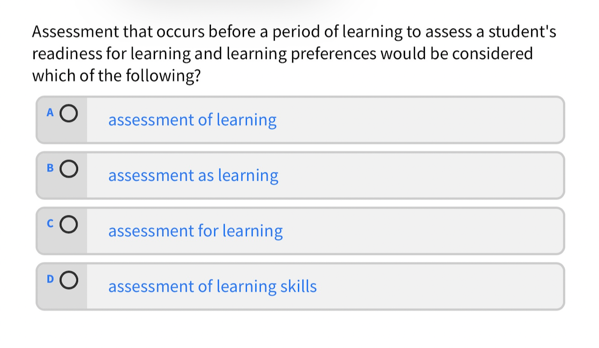
My daughter commented - Yeah…I mean that question would be very easy for someone who’s taken a pedagogy course…but yeah that’s the level of minutiae.
She’s right, this pedagogy part just seems to ask you to repeat the buzzwords you learned in a course. It’s a test of memorization, not of math and logic.
The first part of the test seems like a pretty reasonable way to evaluate if somebody remembers what they were taught up to about 9th grade math. I think that’s a reasonable thing to ask of all teachers. They’re not asking you to do calculus, they’re just asking you to apply some general principles. I heard it said once that All teachers are teachers of language, and I think you could extend that to basic math numeracy too.
But the pedagogy part. That would really trip up people whose first language isn’t English, for one thing. And what’s it doing in a test about math proficiency?
having said that I am delighted to say I got 17/20 on the pedagogy part with some educated guessing, which is also a useful skill. I’ve been lucky to work in the education division of my employer so I’ve been around teachers for a while.
And Cathy reminds me “Didn’t you actually go to teachers college?”
Well, yeah, I did, for three weeks; I am a proud dropout of York University, after a brief, unsuccessful midlife crisis experiment a while ago.
It turns out some of this is hard.
the questions I hoped it would include
Math is a wonderful thing!
Get off your ath and do some math!
Six times a billion is …?
so should there be a math proficiency test?
Yes. Yes there should. Math is a universal language. It is the foundation of truth, and beauty, and has a standard of proof higher than that in any other field of human endeavour.
When we send satellites out of the solar system, hoping they will some day reach a distant galaxy, we engrave plaques on them with math symbols to prove that we are an advanced species. Prime numbers, in particular, are such a fundamental idea that if you can just list them in some language-independent way, like this -
•• ••• ••••• ••••••• •••••••••••
that that’s a good start at demonstrating where you are. There is no conceivable universe where 7 is not a prime number! We have to agree on that with whatever aliens are out there!
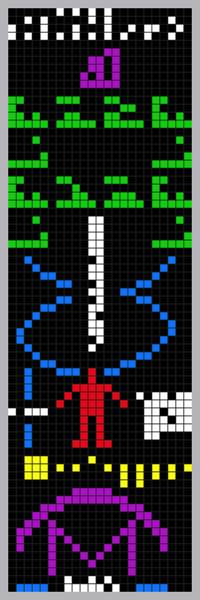
The first radio message beamed out to the stars from the Arecibo Observatory in 1974 was sent as 1,679 binary pulses. Why 1,679? It’s the product of two primes, 73 and 23, and if you can figure that out, you might realize you could arrange the binary pulses into a 23 * 73 graphic like this (colour here added by the Wikipedia article with all the details- but can you see the patterns in there?
There’s a human (red) and a representation of our solar system (in yellow) - notice how the 3rd dot is offset, that’s where this message originated. And more. How much of this can you figure out? Here’s the details.
Isn’t that cool? Yes, yes it is. Math. It’s everything.
But the pedagogy part. That needs some thought. That belongs somewhere else.